Chemicals and critical value chains: Orgalim’s stand on PFAS restriction
Tuesday 17 November: A panel debate on PFAS allowed Orgalim to highlight a wider concern this week: that well-intentioned legislation can create significant challenges for European companies.
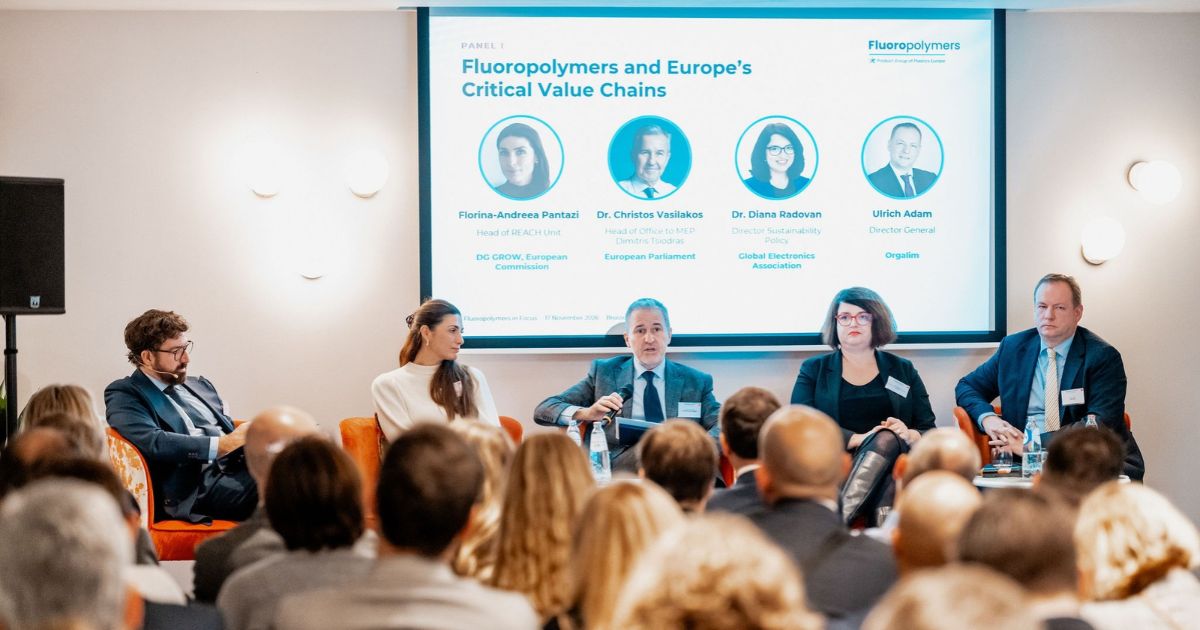
The panel debate, ‘Fluoropolymers and Europe's Critical Value Chains,’ was hosted by The Plastics Europe Fluoropolymers Product Group in Brussels, and brought together policymakers, industry representatives and academics to discuss the proposed EU restriction on PFAS chemicals.
PFAS are a large family of chemicals, often known as ‘forever chemicals.’ They break down extremely slowly in the environment and this persistence is a major environmental concern. However, one particular subgroup, (fluoropolymers) are very valuable in industry largely for this reason: they are exceptionally stable chemically.
However, not all PFAS behave in the same way or pose the same risks. For this reason, Orgalim argues that materials should be assessed and regulated according to their specific properties and application. In fact, most emissions are generated during manufacturing, or in the end-of-life treatment, rather than through normal use in finished products.
Regulating the actual risks, not applying a blanket approach
Representing Europe’s technology industries was Orgalim Director General Ulrich Adam, who highlights that because fluoropolymers resist heat, chemicals and degradation, they help machinery and other industrial products operate safely, reliably and for longer. They are used in everything from semiconductors and electronics to energy, transport, medical equipment and industrial machinery. This is concerning if they enter the environment, but fluoropolymers that have been incorporated into finished products do not typically generate emissions during normal use.
The discussion also highlighted a practical challenge for companies. The proposed restriction includes an 18-month transition period. However, Orgalim’s members produce complex industrial products. Replacing a material in these product would take significantly longer – typically between four and eight years – as it involves redesigning products, testing new materials, obtaining safety and regulatory certifications, and adapting production processes.
Legislation must take account of the time, investment and resources companies need to adapt. If not, the consequences could include discontinued products, disrupted supply chains and increased costs. In some cases, companies could be forced to use alternatives that are less durable or do not offer the same level of safety and performance.
This is another example of the wider challenge facing European industry: When regulatory requirements are too broad or implementation timelines are unrealistic, they create financial and administrative burdens without necessarily delivering better environmental outcomes.
Orgalim's position is clear: regulation should target risks where they arise, encourage substitution where viable alternatives exist, and provide sufficient flexibility where they do not.
Ultimately, this debate goes beyond fluoropolymers. It illustrates why European legislation must be proportionate, predictable and practical. Adding regulatory requirements without considering their cumulative impact risks making it harder for European industry to innovate, invest and manufacture in Europe.
The panel was held under Chatham House Rules and included Ms Florina-Andreea Pantazi, Head of REACH Unit, DG GROW, European Commission; Dr Christos Vasilakos, Head of Office to MEP Dimitris Tsiodras, European Parliament; and Dr Diana Radovan, Director Sustainability Policy, Global Electronics Association.