Europe must simplify its regulatory framework to restore industrial competitiveness
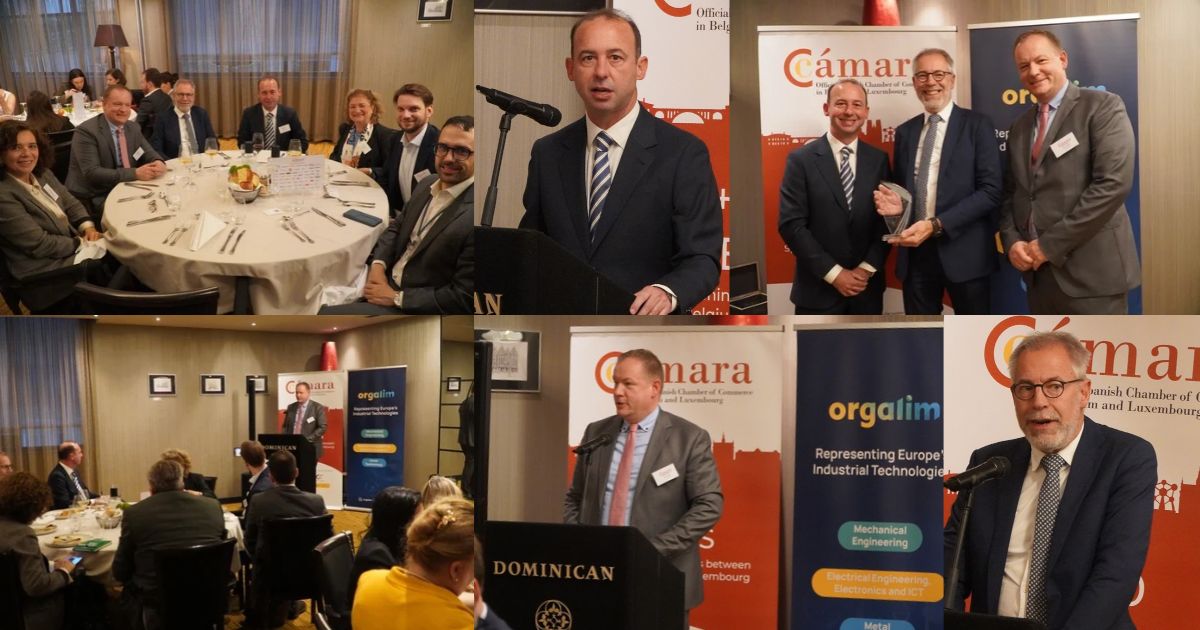
On 27 October, Orgalim was proud to sponsor a lunch debate hosted by the Spanish Chamber of Commerce in Belgium and Luxembourg, featuring a keynote speech by Michael Hager, Head of Cabinet to Valdis Dombrovskis, Commissioner for Economy and Productivity at the European Commission, who addressed the audience on the theme "Beyond the Omnibus: Simplicity by Design for a More Competitive Europe”.
Orgalim Director General Ulrich Adam opened the discussion by underlining the urgency for action: to bring back investment and growth in European industrial value chains, Europe must step up efforts and continue to deliver meaningful regulatory simplification for businesses operating in the Union.
In the past 18 months, Europe has successfully begun to simplify and reduce the massive burdens created by legislation adopted over the past decades. However, as outlined in the Orgalim Simplification Report from April 2026, while the Commission's Omnibus initiatives are welcome and could generate over €7 billion in recurrent annual savings for Orgalim industries, these savings continue to be outpaced by new regulatory costs. Based on the Commission's own impact assessments, recently adopted and newly announced EU legislation would generate an annual cost burden of €81 billion.
Policy developments in September are another case in point: while the proposed Public Procurement Act represents the chance for a real simplification success that could achieve up to €570 million in annual administrative savings, the Orgalim industries were hit at the same time by provisional safeguard measures on Grain-Oriented Electrical Steel (GOES), a measure that will impose €700–800 million in additional annual costs on our industries, wiping out such savings and jeopardising Europe's electrification ambitions.
To break free from this pattern, the EU must double down on its efforts to prevent unnecessary new regulatory burdens from being created in the first place. That is what ‘simplicity by design’ should mean: better regulation, lower cumulative costs and a more competitive European industrial base.
3 key takeaways from the discussion that followed:
- The proof that simplification tangibly improves competitiveness is there – the political case for simplification thus is strong, but must be made. The different Omnibus packages were the Commission’s first attempt to regain industry's confidence following the “regulatory tsunami” of previous years. However, while the case for simplification is strong, it needs to be made so that it continues to translate into meaningful political action;
- The existing stock of decades-old EU legislation presents a considerable structural challenge. The difficulty is not limited to new rules that were proposed in the previous Commission mandate, which the Omnibus packages aim at simplifying. Decades-old requirements continue to weigh on businesses. Regulatory deep-cleaning exercises, matched by equivalent repeals for every new initiative proposed should help address this challenge in the future;
- We must not repeat the same mistakes of the past. Going forward, Europe should try to adopt a more “experimental” regulatory approach, with more sandboxes and less prescriptive regulation, to give freedom and breathing space to businesses. The EU should provide enabling measures and incentives for markets to flourish, rather than directly attempting to create markets via regulation.