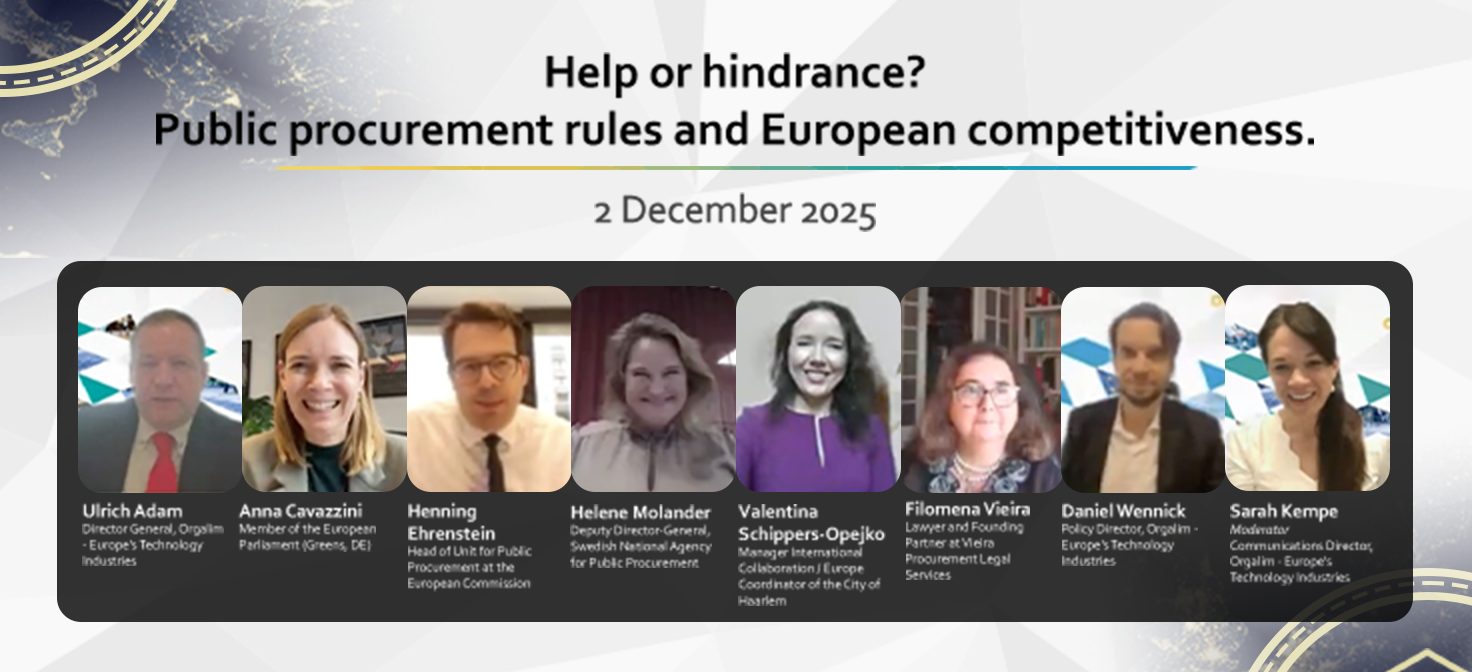
Help or hindrance? Public Procurement rules and European competitiveness
It was 90 minutes of expert insights and genuine enthusiasm for their subject matter from the speakers at Orgalim’s webinar yesterday: ‘Help or hindrance: public procurement rules and European competitiveness.’
The policy exchange covered the priorities for the upcoming review of the legislation and key wishes from the national, local, academic and industrial perspectives. Panellists presented many of the key issues currently faced by buyers, including a much-needed digitalisation of the system, understanding of risk sharing approaches, and the importance of sustainability and innovation criteria alongside cost.
Some of the key contributions from our speakers:
Ulrich Adam, Director General, Orgalim:
Public procurement accounts for around 14% of the EU's GDP, making it one of the biggest and most powerful levers for policy to shape markets and advance strategic objectives. The reform is a unique opportunity to streamline and facilitate procurement rules in line with the EU's broader simplification drive to reduce regulatory burden. In procurement, greater simplicity translates immediately into greater competitiveness.
Public procurement accounts for around 14% of the EU's GDP, making it one of the biggest and most powerful levers for policy
Anna Cavazzini, Member of the European Parliament (Greens, DE):
In the European Parliament, our party has been pushing for a long time to make the procurement rules more strategic, greener, and use them as a means to foster demand for the Green Deal products for the companies that are transitioning.
Our party has been pushing for a long time to make the procurement rules more strategic, greener, and use them as a means to foster demand for the Green Deal products
Henning Ehrenstein, Head of Unit for Public Procurement, European Commission:
Public procurement needs to be part of an integrated European investment strategy, meaning we align public procurement with key EU policy objectives which encompass green and socially sustainable procurement, as well as innovation procurement. In addition, procurement rules need to be simpler, and digital tools can enable simplification.
Public procurement needs to be part of an integrated European investment strategy
Helene Molander, Deputy Director-General, Swedish National Agency for Public Procurement:
The buzzword is simplification, but then the question arises, what do we mean by simplification? For some stakeholder groups, it means fewer rules or more flexible rules; when I talk to policymakers and practitioners, lawyers and other member states, some of them mean more detailed rules, because it makes them feel more secure. We have different business cultures across the union, and we also have the aspect of language barriers. So even though the rules are the same, there are other obstacles which will not be solved by regulation.
What do we mean by simplification? For some stakeholder groups, it means fewer rules [but others] mean more detailed rules, because it makes them feel more secure.
Valentina Schippers-Opejko, Manager International Collaboration / Europe Coordinator of the City of Haarlem:
Currently buyers often have to rank or prioritise what they think is more important: sustainability or innovation etc. For us, actually it's a more strategic approach that is most important. That means we do not silo social or sustainable or innovation criteria, but rather we include them all, from climate adaptation, social aspects, gender equality, circularity and so on.
Buyers often have to rank or prioritise what they think is more important: sustainability or innovation. For us, actually it's a more strategic approach that is most important.
Filomena Vieira, Lawyer and Founding Partner, Vieira Procurement Legal Services:
The starting point is to recognise that public procurement is one of the most powerful, what I would call, bridge we have in Europe. It's a bridge between public sector and private sector. It's a bridge between public interest and economic activity. It's a bridge between societal needs and technological capability. So, through procurement, governments can shape markets, influence industrial capacity, boost innovation and respond to societal challenges. It's not merely an administrative function, it's a strategic governance tool.
Through procurement, governments can shape markets, influence industrial capacity, boost innovation and respond to societal challenges.
Firstly, in total, 98% of Orgalim's membership is made up of small and medium enterprises (SMEs) so I'm happy to hear the call for simple regulation that has come, but then indeed, what does that mean? Secondly, sustainability criteria must be designed in a technology neutral manner. And thirdly, we need to look at the ‘total cost of ownership’ where we look at the cost of products through the whole life cycle. But in general we think this review is a very positive step forward in all three areas.
Sustainability criteria must be designed in a technology neutral manner [and] we need to look at the ‘total cost of ownership’ through the whole product life cycle
The Orgalim team would like to thank Lorenzo Livraghi for leading on this topic. For more information on Orgalim's position and activities on Public Procurement please contact Lorenzo, who is our resident policy advisor for trade and industrial policy.
You can watch a full recording of the webinar below or on our YouTube channel.